

Deadwood is a small town located in Lawrence County South Dakota, on the western border of the state. It was settled illegally in the 1870s in a region of land that was granted to Native Americans. When gold was found by General George Custer in the Black hills and valleys in the region, the settlement sprang up, and quickly boomed to a population of 5,000 people within the first years of its establishment. As it was an illegal settlement, and governed initially by no territory or country, it was a lawless place, filled with gold prospectors, twisted businessmen, and general riff raff.
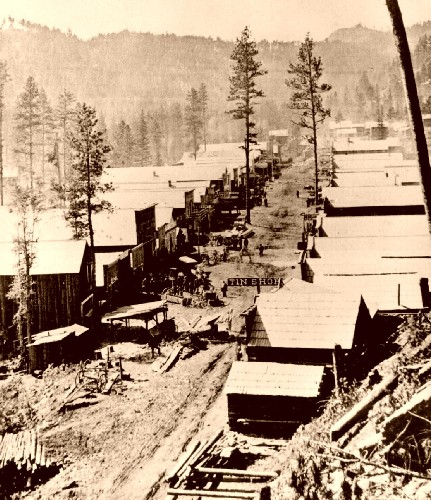
In 2004 HBO, the gods of amazing television productions, took a chance on a TV series based on the history of the town, whose story begins immediately after the defeat of Custer at Little Big Horn. Numerous characters from the history of the old west and the town played key roles in bringing the town to life for audiences. The series explores the development of an isolated social system, in an ungoverned region of what at the time was considered “wilderness”, and the interactions of the people who find themselves torn by a growing sense of community, and the inherent self serving attitudes of a gold rush settlement.
The insane crudeness of the show, including every possible profanity known or ever uttered, as well as the immense dependency on amazing actors to portray true life town members during the time period, really helps to establish Deadwood as a top tier television series that sprang from the mid 2000’s re-serialization of television.
Along with shows like ABC’s Lost, HBO’s Sopranos, Rome, and Six Feet Under, Showtime’s Dexter, and later AMC’s Breaking Bad and Mad Men, Deadwood as a series, really illustrates the depth of story telling, the power of dialogue and the amazing ability and faith a production house has in creating a world that can fully immerse the viewer.
HBO’s productions during the last 10 years stand above and beyond any other network however, due to the limitless possibilities that a non broadcast network offers. The lack of content censorship lets any series produced in the HBO system to push the limits of what is considered “decent” for modern television. Deadwood does not disappoint, dropping every obscenity, scenes of extreme sexual nature, plenty of nudity (male and female), and of course extreme and often disturbingly graphic violence. But it all serves the show so well; I can’t imagine it without it.
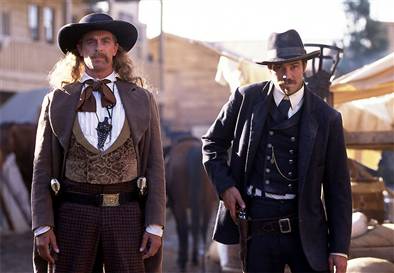
David Milch, the creator, executive producer and writer of Deadwood is a dialogue genius. He is a wordsmith that builds character not only through actions, but through the eloquent manipulation of language, varied across every social stratum; with accuracy the modern person can only assume to be authentic. And even if it isn’t authentic, it sure sounds so freaking good.
The true genius of Deadwood is within the synthesis of this craftsmanship. This is a story of expansion, greed, and the lust for wealth and happiness, the true American dream. Individual needs versus the needs of the community, the battle of morality versus the needs to act immoral for the “good of the people”, and most prominently later in the show, the struggle of a community battling the inherent capitalistic tidal wave that washes over what once was a self contained and operating town. The powerful themes of this show not only touch on modern American ideals and beliefs, they make you feel like you are a part of this world, and you know these people. From the dirtiest murdering henchman, to the endlessly moral and bad tempered Sheriff, to the skankiest whore at the whorehouse, after 3 amazing seasons, Deadwood still feels like home.
I highly recommend it to anyone who loves a good story, and doesn’t mind being a little offended.
A little taste of Deadwood:
For those who are concerned with obscenity, here is a website for you to check out before you watch. Beware, this website is a little obscene:
http://www.thewvsr.com/deadwood.htm
And to go along with that, here is some music from Johnny Greenwood:
http://www.mediafire.com/?4acxxxjt1ns
Johnny Greenwood: Bodysong (2003)

1. "Moon Trills"
2. "Moon Mall"
3. "Trench"
4. "Iron Swallow"
5. "Clockwork Tin Soldiers"
6. "Convergence"
7. "Nudnik Headache"
8. "Peartree"
9. "Splitter"
10. "Bode Radio/Glass Light/Broken Hearts"
11. "24 Hour Charleston"
12. "Milky Drops from Heaven"
13. "Tehellet"
More about Johnny Greenwood, from Wikipedia:
Jonathan Richard Guy Greenwood is a BAFTA and Grammy-nominated musician and composer, best known as a member of English alternative rock group Radiohead. Greenwood is a multi-instrumentalist, but serves mainly as a guitarist and keyboard player. He is the younger brother of fellow Radiohead member Colin Greenwood.
In addition to guitar and keyboard, he fluently plays viola, xylophone, glockenspiel, ondes martenot, banjo, harmonica and drums. He also does work on the electronic side of Radiohead, working on computer-generated sounds and sampling. He wrote the soundtracks of the films Bodysong and There Will Be Blood, as well as serving as "composer-in-residence" for the BBC.
"Bodysong" is a 2003 documentary about human life directed by Simon Pummell.

No comments:
Post a Comment